When we got off our expedition boat in Coron harbour, we were already hugely looking forward to a long, warm, cosy shower. To celebrate the end of our time on the Philippine islands, we had treated ourselves to a slightly more upmarket hotel with a pool and were glad and excited to be able to check in soon.
Coron is a small island municipality on the island of Busuanga in the province of Palawan in the Philippines. The place is known for its breathtaking landscapes, including picturesque islands, bays and cliffs. It's also a popular destination for divers and snorkellers, as there are many sunken Japanese warships from the Second World War to explore, lying in relatively shallow water. Coron is also famous for its crystal-clear waters and white sandy beaches, perfect for relaxing and unwinding. Coron was the destination I had been looking forward to most, and our expectations were completely fulfilled here.
We had arranged a private boat tour for our very first day on Coron with Helena and Tim, the German couple from the El Nido Paradise expedition. We met at the local – and only – market to buy ingredients for the tour lunch, which the boat's cook would then prepare for us. We asked for all sorts of vegetables with fried garlic rice and some fruit. The market was anything but pretty or exciting to look at. At times you had to hold your hand or a cloth over your mouth because the smells were so pungent and penetrating. It consisted of 4 aisles in a corrugated-iron hall, where we gathered our fruit and vegetables. The first aisle was the meat and fish aisle – hence the smell. Dried and fresh blood lay on the floor in places, and the blazing heat beating down on the tin roof turned the whole market into a hot, strong-smelling kiosk. On the fish counter we discovered various whole or cut-up moray eels and rays, which we would of course have preferred to see in the water. The other aisles were for vegetables, fruit and grains or other things. So here we experienced a real, unvarnished piece of Southeast Asia.
This time the four of us had a really small banka boat, with room for just the captain and the cook besides us 4 tourists. We discussed the route with them. Since it was a private tour, we could arrange it the way we wanted, and the captain tried to find the best times to reach the spots so that tourist rush hours could be avoided.
First we headed to a highly praised coral reef. We could start leisurely from the boat or from a wooden platform where we anchored.
Unfortunately there were only very few healthy corals, and it was a bit wavy at the time, but I immediately discovered 2 moray eels moving freely in the water and showing off their full length. We got on splendidly with Tim and Helena, the weather was perfect, and so we soon sailed on to the next spot, the Twin Lagoon.
The lagoon was a totally beautiful, elongated basin framed by high limestone cliffs. The water was light turquoise. We even discovered a trusting barracuda that calmly stayed among us next to the rocks reaching down below the water.
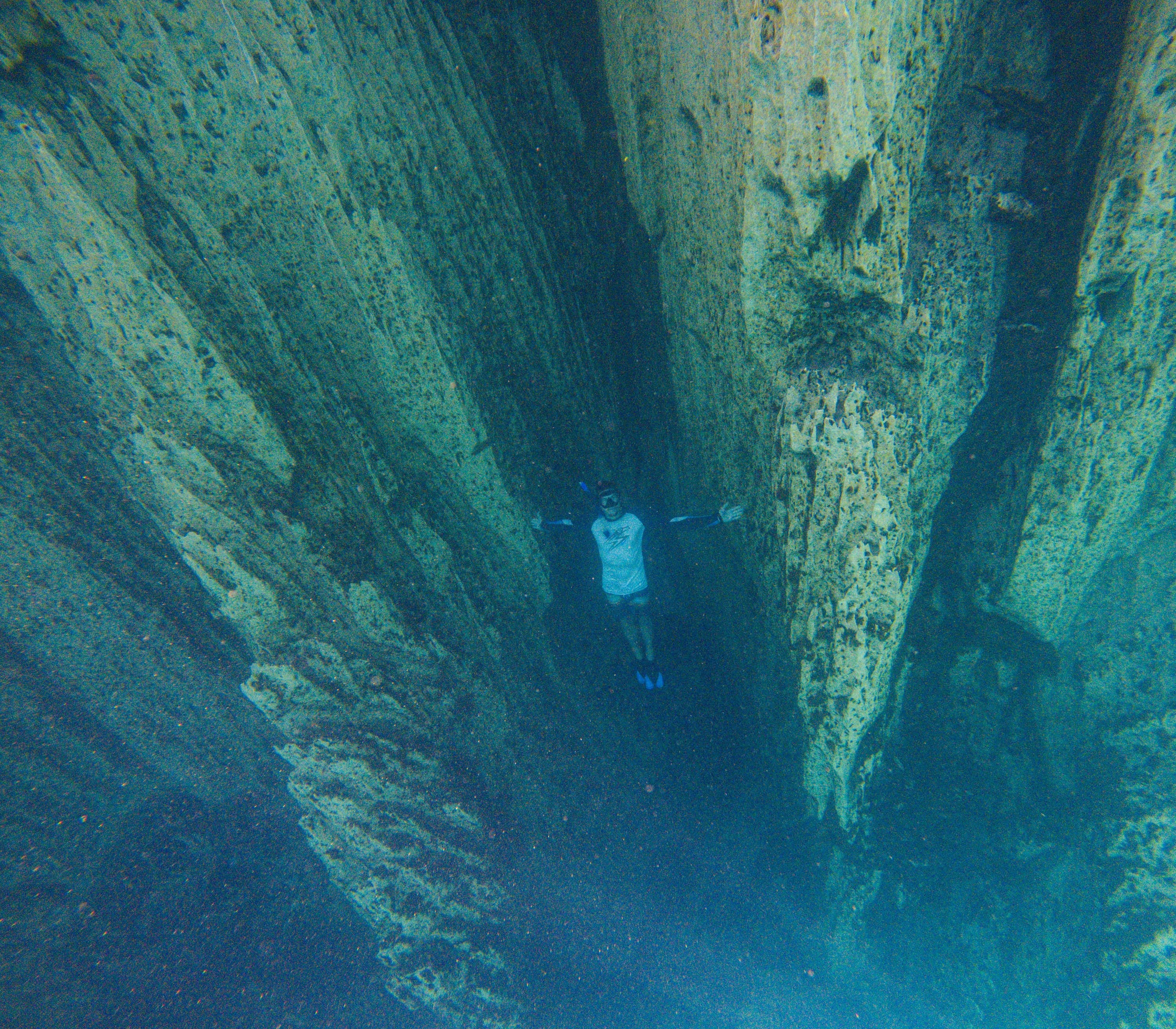
This second spot alone had already made the boat tour worthwhile. But then it was the turn of the two famous bays, "Barracuda Lake" and "Kayangan Lake", which still managed to outshine the previous wonderful spot. At both places the rock walls with their striking shapes reached all the way down to the bottom. The water was crystal clear and turquoise blue. You found a completely separate underwater landscape of rock that was reminiscent of human architecture. Simply lingering at these places, bathing and drifting in the water (everywhere you were made to wear a life jacket, which we took off now and then to dive deep) relaxed me more than any other place we had visited so far had managed. There was so much structure to marvel at underwater. Small shrimps and needlefish also gathered near the rocks. Kayangan Lake isn't very deep at the spot where you're allowed to swim, so you can look all the way down to the sandy bottom. There are also some rock ledges forming a grotto and even a small cave to swim into.
Barracuda Lake, the main attraction of Coron island, on the other hand, is somewhat deeper at the accessible swimming spot than Kayangan Lake. As soon as I jumped into the water first, I spotted the famous lone barracuda (or its successor) the lagoon is named after. Unfortunately it had already dived away again before I could show it to the others. Above water the lake is surrounded by impressive limestone cliffs and lush greenery, offering visitors a wonderful nature experience. Here too the limestone cliffs reach all the way down to the bottom and form a dream backdrop for diving down and along them. Since it's a lake, we had less buoyancy than in seawater, and the short fun freediving went much more easily.
I had the feeling I had never dived so far down so easily as here. However, we couldn't measure the depth. I think it's time we got ourselves a dive watch. But what makes this lake so unique, apart from the exciting underwater rock scenery, is its unusual property that the water has different temperatures at different depths. After his first deep dive, Chris told us in amazement that it suddenly became really pleasantly warm. We later found out that from a depth of 14 m it's about 38 degrees Celsius.
Here's what we learned over the following days: the upper water of the lake is pleasantly cool and clear. Then comes a warm (38–40 °C) layer. The transition zone, more than 15 m, between the two layers is called the "thermocline". After this layer it gets dark and cooler again. So during the dive, divers experience an amazing phenomenon in which they suddenly plunge from cool, crystal-clear water into warm, crystal-clear water. The transition from cold to warm is noticeable as a shimmering zone. If you look closely at our attached video, you can even see the transition between the layers of different density.
Barracuda Lake is a mystical, breathtaking place that we were able to experience in a really great way.
To end our first outing we went to Siete Pecados, a reef near Coron's hot springs. It was a great snorkelling spot, but with a strong current. Currents are really not my thing, so I spent more time on the boat than the others. For Chris it was no problem, and he was able to watch super cool fish, sea cucumbers and anemones there.
A wonderful, impressive first day on Coron came to an end.
Over the next few days we visited the hot springs to relax. For the rest of the days we arranged to meet our new Bavarian friends for games of pool and meals.
Since I had liked Barracuda Lake so much and guided freediving sessions were also offered there, the four of us booked a fun-dive outing with the local freediving centre for the coming days. So we got to experience this mystical place intensively twice.
On this outing Chris, Matthias and I could try out our new depths on the guide line. Thomas was content with snorkelling. Since we were out with the freediving coach, we were allowed into the deeper part of the lake, far beyond the cordoned-off area for tourists. This had the big advantage that we could admire and swim along more great mini bays and rocks of the lake. I had been looking forward to this outing so much, but on exactly this day my airways started to go on strike again, and I could already feel my by now chronic bronchitis probably taking over again.
At least on the first dive I managed my 10-metre mark. However, it felt much less deep than my own attempts on the previous visit to the lake. Chris set a new personal record of 31 metres freediving. So he could see and feel the thermocline up close. This time the big barracuda kept swimming curiously very close past us. We had good opportunities to watch it. Another great day came to an end, and soon we also had to say goodbye to the last of our new German-speaking friends.
We still had a good week left in Coron and planned a few more outings. Unfortunately, a nasty relapse of my cold then put a spanner in the works, and I had to take it easy for the remaining days, as even a walk was too exhausting for me. Chris looked after me lovingly. Luckily we had a great hotel with a pool – that makes being ill a lot more bearable.
Soon this last week was over too, and we flew via Manila on to Australia.
As always, we share our great experiences with you in moving and still pictures and hope you enjoy looking through them. Don't forget to look out for the thermocline in the video. Maybe you can spot it.