The next leg of our journey began with the ferry crossing from Picton (South Island) to the North Island and the capital, Wellington. The crossing was already exciting on land, as two ferries were out of service due to engine damage, replacement places became scarce, and loads of tourists and locals queued at the ferry terminal from 5 a.m. on the following days (as did we) to somehow still grab a place for themselves and their van on a ship. Fortune was on our side. A day and a half later than planned, we crossed the strait between the North and South Islands with another ferry company and enjoyed the great view of the Tasman Sea, accompanied by several pods of dolphins.
In Wellington, with the aim of cultural enrichment, we visited the Te Papa National Museum. We found the current special exhibition particularly exciting. It tells the story of the Gallipoli campaign in the First World War from the perspective of eight ordinary New Zealanders who found themselves in extraordinary circumstances.
Each person is recreated as an impressive, lifelike sculpture at a specific moment in time – 2.4 times human size. The artists behind these figures belong to the well-known Weta Workshop, which was also responsible for the figures and masks in the "Lord of the Rings" films.
So, already tuned in to film sets, we continued to Tongariro National Park, where the scenes around "Mordor – Mount Doom" and "Gollum's Pool" in the blockbuster mentioned above were filmed.
For the first time, it had reached zero degrees at night, and at our remote D.O.C. campsite we snuggled up in our van even closer than we had anyway so far. In terms of warmth, this wasn't nearly as bad as you might think. Only getting out, or going to the loo at night, isn't much fun any more at these temperatures.
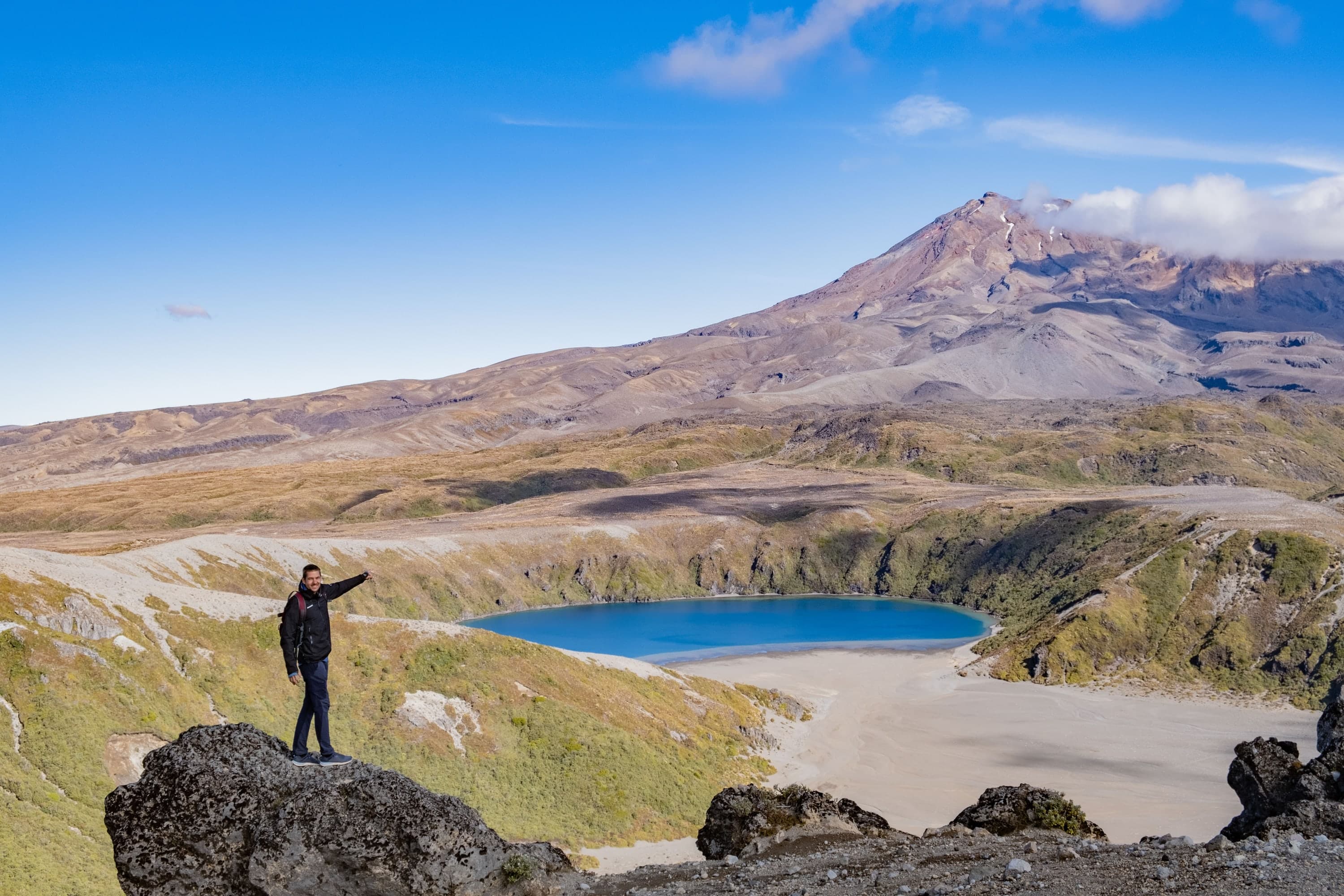
Our chosen hiking route (the Upper Tama Lakes Track) took somewhere between 4 and 5 hours (with photo stops, things like this often take us 1.5 hours longer) and led up into a cooler and, above all, windier climate zone. A great feeling to hike up with constant views of Mount Doom, where the One Ring met its end.
If Frodo and Sam had had a gas stove and the instant soup that has become obligatory for us, it would probably have been a bit easier for them to climb Mount Doom.
As always, we only occasionally met other hikers, and once again we were treated to incredible photo backdrops. Most of the time we were completely alone.
Tongariro National Park (and we have to say we only hiked through a small part of this huge area) was a very special highlight of this trip. After Abel Tasman we had already thought we'd left the more beautiful island behind us. But now the north also offered incredibly spectacular views of mountains and valleys. Here too the Thai motto applied: "same same but different".
Another natural highlight was the Waimangu Valley near Rotorua. Waimangu Valley is a geothermal attraction on New Zealand's North Island. It's the only geothermal park in the world created by an explosive eruption. The valley is home to numerous hot springs, fumaroles and colourful crater lakes. You hike down a marked path into the valley and are then driven back up by bus.
Optionally, once at the bottom, you can also take a short boat trip on the valley lake. Unfortunately we can't tell you anything about that. We were already so busy looking at the geothermal activity, including sulphurous acidic pools and fascinating plumes of steam, and had covered our boat time sufficiently in Southeast Asia, that we gave it a miss this time.
We then continued to the Waikite Hot Pools and the volcanic valley at Wai-O-Tapu.
The Waikite Hot Pools are a thermal complex near Rotorua, famous for their natural hot springs. Visitors can relax in the various pools and enjoy the healing properties of the warm thermal water while gazing admiringly at the surrounding nature. Conveniently, this was also a camper-van site, and we managed to snag one of the much sought-after pitches. So we had a natural thermal spa visit included.
The volcano theme continued, and from here we booked our day tickets for the volcanic valley at Wai-O-Tapu straight away.
The volcanic valley is part of the Wai-O-Tapu Thermal Wonderland, another geothermal park near Rotorua. Here you experience impressive geothermal phenomena, including bubbling mud pools, colourful hot springs and the famous "Champagne Pool".
The landscape is characterised by intense colours, due to mineral deposits and chemical reactions, giving the place a surreal-looking atmosphere.
We particularly loved the almost neon-green pool with a pH value of 2.
Here you met a few more visitors. The park is also only open a few days a week and is designed as a really large-scale tourist attraction.
From this well-visited site, though, we went straight on to a real tourist stronghold: next came a visit to Hobbiton, the famous film set from "The Lord of the Rings" and "The Hobbit". A clever sheep farmer, who had leased his pastures to the production company as a film set during filming, pulled off a brilliant plan: when the Hobbit sequel was filmed years later, he only let the production company rent his pastures on condition that the film set could not be dismantled after filming. By now he (and Peter Jackson) have turned the huge site into a large-scale film park open to tourists.
Many people ask us – just as we asked ourselves beforehand – whether it's worth visiting this film set for a really hefty entrance fee. Our answer: if, like us, you're fans of the LOTR and Hobbit series and you stay close to your location guide to catch all the information and funny filming anecdotes, then a big YES. If you just walk through Hobbiton on your own to take photos, you miss the real thing. The individual doors, ponds and little houses become much more special when you also learn the stories and how they were built.
Afterwards our journey took us through Tirau, a town known for its merino wool products and huge corrugated-iron buildings in the shape of animals. We found this spot a bit overrated. Apparently natural sites appeal to us more. So we continued to the Blue Spring Walk, also known as the Te Waihou Walkway.
Here crystal-clear water, untouched by humans, awaited us, whose transparency revealed beautiful water plants in every imaginable shade of green. Like an underwater jungle with a current.
We spent Easter (yes, it really is a while ago now) on the picturesque Coromandel. This is a popular destination, especially for New Zealanders themselves, as there are calmer, milder beaches here where you can also do water sports. You surely remember the videos from the South Island tour – you'd rather not set foot in that rough sea just to swim around leisurely. We only stayed on the Coromandel briefly. But we did manage a fun historic train ride on the famous mini railway that an immigrant artist had built with his own hands.
Partly we kept this trip to the north of the island short because we wanted to visit our only New Zealand acquaintance before he, like many other Kiwis, escaped the winter to warmer Bali. We had met Henry as a great boat mate on our freediving safari near the Moluccas and took him up on his invitation to get in touch if our world trip ever brought us to his home town of Auckland. We had a few extremely nice days with Henry and used the opportunity to finally sleep in a regular bed again. It took us about a week to sell our car before we caught our onward flight to Perth, Australia – to visit our second diving travel acquaintance, Nat.
But that's yet another story.
Enjoy looking through the pictures. Maybe you'll also notice how few other tourists can be seen on our tours in the videos. That speaks for the vastness of this wonderful country, which we're now going to miss terribly.