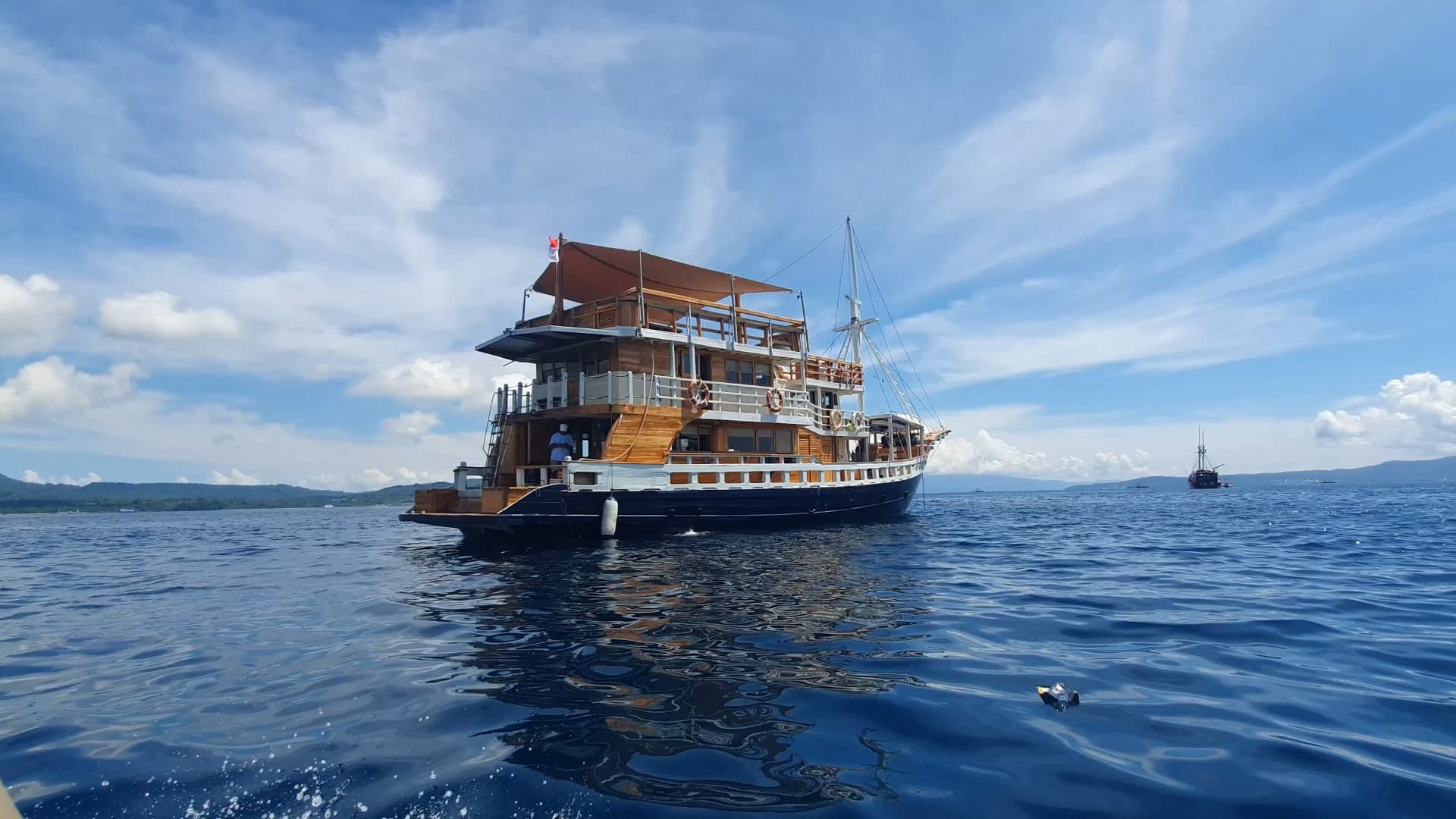
As luck would have it, the freediving school where we had done our freediving certificates at the start of our world trip was organising a boat safari from the Moluccas to the northern marine national park of Raja Ampat, which was already a fixed point on our world-trip list. Since we already trusted the Apneista team from Bali/Amed a lot, and our cheerful British workshop teacher Anna would also be on board, we decided to explore the Moluccas and the Banda Islands all the way up to West Papua (the Indonesian part of New Guinea) together with them by boat, rather than having to choose one spot and get there on our own.
Even before our departure from Vienna we had heard that the marine national park around the 4 islands known as the 4 Kings (Indonesian: Raja Ampat) is said to be one of the most beautiful diving areas in the world. Through my internet research I found out that there are beautiful soft corals, sea fans and even walking sharks to admire there at not too great a depth (if you're lucky).
Unfortunately, this destination was supposedly very complicated to reach again, and some travellers reported on their struggles to get there and on cancelled or postponed flights.
We were really curious about what awaited us on our so-called "liveaboard" (boat hotel).
On top of that, we could train our newly learned freediving skills with the Apneista team while exploring a completely different, new underwater world, as the liveaboard took us to all kinds of dive spots. A liveaboard is a boat that isn't just for day dive trips – you live on it the whole time like in a hotel on the water and do the dive safari from there without having to go ashore. Neither of us had ever spent more than a few hours on a boat, so it sounded very exciting and definitely like an adventure.
After a long, tiring journey with 3 flights in one day (the predicted rebookings had happened), we arrived in Ambon, a port town in the Moluccas, to be taken from there to the Mikumba II, our new home for the next eight days.
The Mikumba was a large wooden boat with room for 10 passengers and a crew of 9.
Our cabin was super cramped and anything but cosy, but we gladly put up with that in the hope of spotting new animal species.
Shortly after boarding, things got going with plenty of action on the first water outing – and that's how it stayed until the end of our tour.
At first my stomach made it unmistakably clear to me that it isn't suited to swaying boat trips, and I had to resort to tablets for travel and seasickness. Luckily we were often in the water, where my body always feels great.
After a few days I had also got used to the constant swaying.
You can picture our daily routine roughly like this:
Get up very early in the morning and optionally take part in the morning session (6:30–7:30). The morning session included breathing exercises and stretching for freedivers – and since I was on board too and Anna had unfortunately caught the flu, there was later also stretching with Danie and an urban dance lesson.
Afterwards there was an ultra-light fruit snack as a first breakfast, and then it was time to get into our wetsuits. Fins, masks and weight belts were provided, and all participants climbed into our 2 speedboats (dinghies), which took us to great nearby dive spots every day.
We then dived and snorkelled around in teams, and if you wanted to be taken back to a certain spot without swimming against the current, you just had to wave to the dinghies and they picked us up and dropped us back in the water a few hundred metres further on.
We found that a fantastic service, and it meant we could concentrate on diving instead of using up energy and breath on swimming. Once the whole team was in the water, the speedboats reliably watched over us, drifting nearby, ready on call should anyone want to go back to the Mikumba II.
On the very first dive we came across great corals and sea creatures. The trip had been very expensive, but obviously the right decision.
Back on the boat there was time to rest and the proper breakfast. We quickly learned that we had to tuck in here, because apart from another small snack after the next dive there was nothing else to eat until dinner.
A weight-loss sports week, then.
We always ate together at a large table on the ship's sun deck. Afterwards everyone soon slipped away to their sleeping place, as every day meant getting up early and hard work all over again.
Anyone who got up early enough experienced a special sunrise at sea every day – and once even a humpback whale greeting our ship with its tail fin.
But what made this trip so special, apart from the great dives, was the wonderful time with the whole team on board. We had made friends very quickly; everyone shared a love of nature and water as a common denominator. You immediately felt like a community, joked and fooled around on the speedboat rides and at the shared meals. Since most of us even shared a cold one after another, we helped each other out with medicine and remedies – only to forget all our aches and pains as soon as we were in the salt water and having fun. The Indonesian crew were super kind and accommodating and often joined in our fun. For eight days we lived the romanticised image of a film pirate crew.
Besides us, there were freedivers from Spain, New Zealand, Russia, the UK, the USA and Switzerland on board.
We made music together, played cards or simply rested quietly side by side on the cushions on deck, since from day 2 at the latest everyone needed a lot of sleep.
Our tour "dad" Kwab always scouted the dive spots in advance and then explained on the whiteboard what we should watch out for, where we could swim and which fish and corals could be found at that spot. Since he was British, I enjoyed these explanations more than anyone else – you may already know how amusing I find the British accent.
And so it went, day after day, from one spot to the next. The Mikumba II alternately sailed the long distances through the Banda Sea and to the edge of the western Pacific both during the day and sometimes at night, taking us from the Moluccas down to the isolated Banda Islands in the south and then far up north again through Raja Ampat National Park.
Twice we made a shore excursion to an island, and on 2 evenings we were also taken to remote beaches to admire the sunset.
One of my personal highlights was the chance to try "skurfing" on the surfboard Kwab had brought along. You can imagine it like wakeboarding, where you're pulled by a speedboat. Instead of a wakeboard with fixed boots or straps you slip into, we used the surfboard barefoot without any bindings, which made things more difficult (see video).
Since we were in the middle of the sea, you had to do a water start. Floating on your back, you pulled your feet up to chest height and somehow had to get a grip on the surfboard so you could stand up and balance while the speedboat set off.
Chris and the New Zealander Henry already knew similar sports, so they both cut a great figure on the surfboard right from the start.
For me it was an opportunity to learn something new that I definitely didn't want to miss. (Anyone who can read between the lines will know that this is a nice way of describing my many belly flops and false starts.)
Since the water start was a big problem for me, but I rarely give up, the spectators on the distant Mikumba II cheered loudly when, after many attempts, I stood up on the surfboard for the first time and could enjoy the skurfing.
At first my husband helped me by supporting me as I stood up, while he himself was swimming in the water, so I could do a first round of skurfing. Which, however, meant he had to wait alone, drifting in the middle of the Pacific, until the speedboat and I had finished our round. That must be true love.
Another highlight were the nights on the ship. Since I didn't feel comfortable in the cabin at all, I moved out to the sun deck with my mattress and spent the remaining nights sleeping under a breathtaking starry sky in the fresh sea air. Definitely recommended!
On one of the days there was another dive workshop on the line. I skipped it because I had a cold and paddled around the area in a kayak. That day Chris passed the 25 m mark and was over the moon to have had this experience.
Over the course of the week we visited great dive spots and saw dolphins every day. We dived through passages, into 2 caves, snorkelled through turquoise lagoons and through a forest full of large jellyfish. We saw all kinds of soft corals as well as the large gorgonian sea fans we had never seen before.
Once we followed dolphins in the speedboat, then saw a humpback whale on one side, only to jump into the water on the other side because a larger group of reef sharks was swimming beneath us. Everything was so exciting and impressive.
At another spot we found nudibranchs (colourful sea slugs), squid and scorpionfish on the steep underwater rock walls.
Most of the time we snorkelled and dived around one of the many mini islands or rocks and told each other where there was what to see.
When I felt that this freedive safari was coming to an end, I became really sad. We'd had such a great time, been so close to nature, and you already started missing the new friends, because on a smaller boat like this, with so many shared mini adventures, you grow quite close.
In the remaining time we also did a night dive. That was also one of the most memorable experiences for both of us. Equipped with our torches, we snorkelled along the reef in teams of 2 in the dark to find the nocturnal residents.
Very proudly, I was the first to spot a walking shark and told the rest of the group. And not just lying on the bottom – it actually waddled a short way on its fins to get away from the light of our torches. We spotted 4 more of these cute little sharks.
At the end of our night dive we gathered and switched off our lights to admire, in the darkness, the bioluminescence of the plankton in this area, which you could see as sparkling streaks when you moved your hand through the water.
In one particular area of the national park, unfortunately, we were also confronted with the waste problem of the world, and of Indonesia in particular. The tides and currents had driven a lot of it together here.
For at least a day our ship manoeuvred through completely filthy water and countless pieces of plastic waste. And that in the uninhabited national park! I couldn't stop thinking of all the innocent and wonderful sea creatures whose habitat was now deeply polluted. So dense that every time anyone surfaced, their head was framed by rubbish – whether whale, fish, turtle or human. Underwater, too, we kept seeing plastic waste hanging on the corals. A deeply depressing sight.
Our list of top marine sightings is led by humphead parrotfish and includes, among others, walking sharks, tube corals, giant sea fans, corals that look like cauliflower, giant clams, pipefish, turtles, rays, eels, moray eels, barracudas, large sweetlips, Napoleon wrasse, blacktip sharks, grey reef sharks, jellyfish species, triggerfish species, crocodilefish, scorpionfish, lionfish as well as countless kinds of perch and parrotfish, etc...
We had a great, unforgettable time that, like all beautiful things, was over far too quickly. Life lessons and underwater lessons included.
With this report on a trip that is already a little while ago, we're writing to you from Bangkok and wish you a wonderful and peaceful Christmas today, 24 December 2022.
That we're so behind with our reports is a good sign. It means our time is filled with lots of wonderful moments and there isn't much time left for the computer. Still, we'll try to tell you soon how we ended up spending Christmas in Bangkok.
As always, enjoy our short video summary and the photo gallery: