Our journey north started with a night on the sleeper bus. Personally, I had serious doubts about getting through this trip well, as it meant a good 6 to 7 hours on a bus without a toilet. But when we were shown to our sleeping cabins on the bus, we were very surprised at how modern and comfortable the individual cabins were. Extremely spacious for me, a little less so for Chris, they offered a padded lying surface, a shelf for drinks provided by the company (which you'd better keep your hands off, because you can't go to the loo) and a curtain to the aisle for some privacy. Light and air conditioning can be adjusted individually in the cabin, and you can conveniently charge your phone at a USB socket.
The sleeper buses leave late in the evening and drop you off early in the morning at your destination for around €20. So in theory you save a night in a hotel and can go on a tour straight away the next day. Since we didn't yet have much faith in this way of travelling, we booked accommodation in Sa Pa for the remaining half night just to be on the safe side. Let us tell you: we now know that hotels in Vietnam are generally set up for the tourist-sleeper-bus combination, so they usually have somewhere to sleep for the rest of the night – a couch, a bed in a dorm or simply a lounger at reception.
Our accommodation, the Heart of Sapa, was one of the cutest hotels we've had so far. Super clean, comfortable, lovingly furnished and yet extremely cheap. The Vietnamese owners took loving care of us and were there to help at any time of day. Here in Sa Pa the air conditioning is used for heating rather than cooling, as it can get really cold at night – even though you should protect yourself well with sunscreen on the day hikes. From our room we had a great view of the many high mountains lining the valley. At night the little town reminded us of a dreamy Austrian ski resort. Narrow lanes, lots of little stairs evening out the hilly terrain, and souvenir shops and restaurants along the way. Among other things, the shops sold hiking clothes and thick jackets. Lots of things were decorated with lights, and traditional lanterns and garlands hung across the lanes. Everything from hostels to luxury accommodation could be found here.
We rented a scooter and made day trips to the Silver Waterfall and the Love Waterfall, as well as to some viewpoints. The Vorarlberg company Doppelmayr built the longest three-rope cable car in the world (!) right here, and we would have loved to ride it. It runs from just outside Sa Pa up Mount Fansipan. Unfortunately we were there exactly in the maintenance week, so we only admired its route from afar and skipped the trip up the mountain whose name sounds like something from a pastry kitchen. The wide asphalt roads were in top condition – different from what we had expected. However, buffalo and goats had right of way, and we actually had to dodge groups of cattle wandering around on their own in the middle of the road.
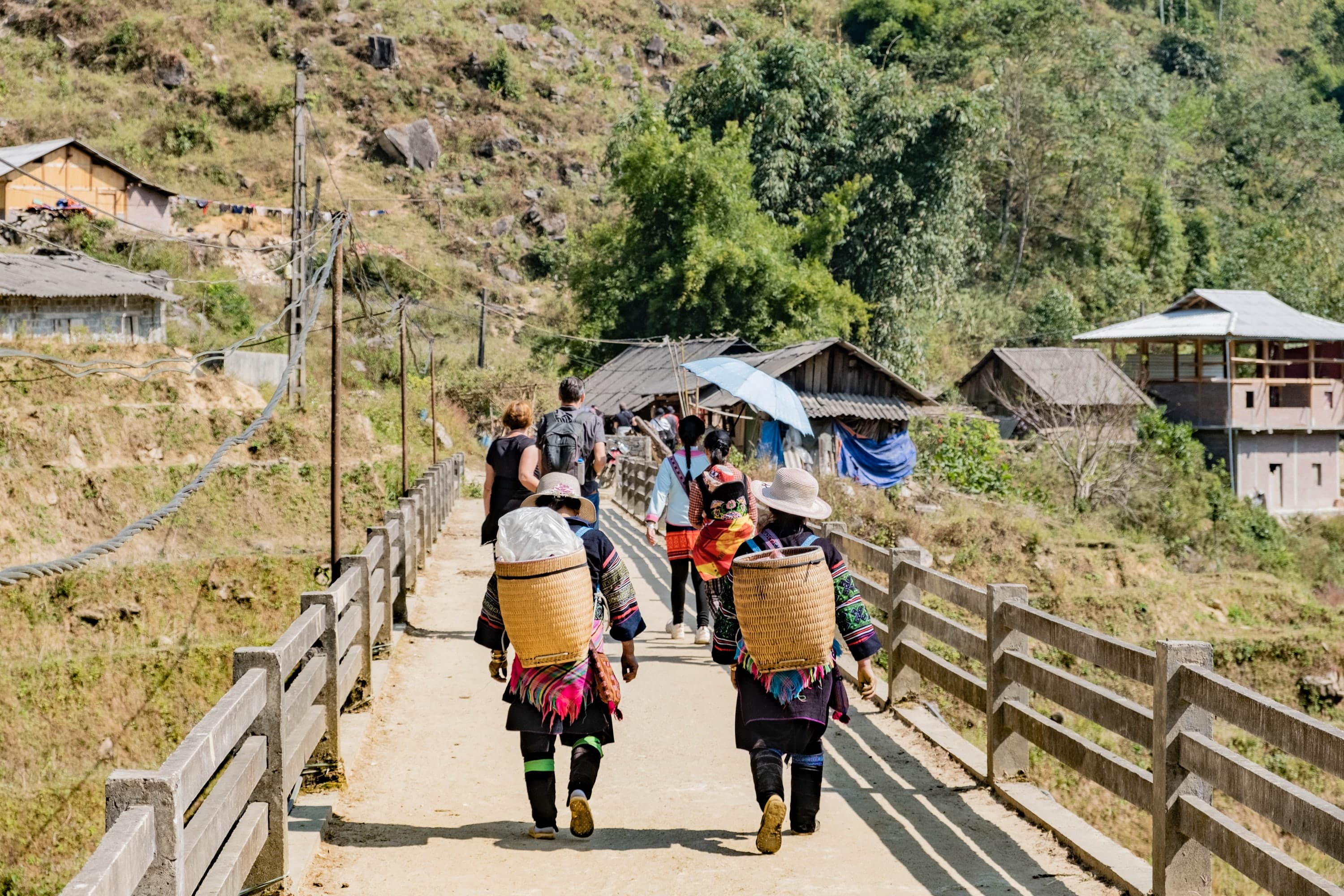
In the evenings you went to one of the many restaurants to treat yourself to a well-deserved dinner. On the very first evening we happened to sit next to 2 other Austrian couples travelling from north to south. That's how we made new friends, with whom we kept each other up to date in chats about our experiences, recommendations and tips even after going our separate ways. On the second day our accommodation arranged the guide Pang for us, from one of the mountain peoples. With her and two young French travellers we did a 15 km hike through the valleys and visited the traditional villages and the bamboo forest. Since she lived and grew up in one of the villages, she told us all about the traditions and life in Sa Pa, and we could ask her about everything that interested us.
So we learned a lot about traditional huts, the way of life, which peoples live here and how the traditional costumes are made.
On the last day we also visited Cat Cat. This idyllic village was built down a slope to where a stream flows out. So you wandered along waterfalls up and down countless stairs in the narrow lanes to see the whole village. Once you'd done the whole descent, you walked along the huts up the stream to the other side of the valley, past water wheels and wooden bridges, where moped taxis were already waiting for the tourists to take us back up the mountain to Sa Pa. Cat Cat Village has been completely turned into a sightseeing spot. There are even show houses and huts and traditional performances. You pay an entrance fee to visit the whole village. Traditional costumes are rented out so you can walk through the village in them and take great pictures. It's a bit reminiscent of a Vietnamese western film set with a Hallstatt-style tourist atmosphere.
Tired, we went to bed and got ready to get up very early the next day to travel even further east by minibus. Our next goal was to explore the famous Ha Giang Loop by motorbike and admire the breathtaking landscape of northern Vietnam from high up along the way.
As always, enjoy our short video and the photo gallery.