Right after our freediving adventure we headed off to the island of (Gili) Meno, part of the Gili trio east of Amed. All we wanted there was to take a break and enjoy that classic beach feeling.
A short boat trip takes you to the first Gili: Gili Trawangan, the party island, popular with partying Australians, Russians and French. From there you had to organise a small boat to hop over to the next island and get to your accommodation. Wading through the water to change boats, we got to dip our legs into the dark turquoise water for the first time. We had chosen a slightly more upmarket place that supposedly placed more value on sustainability and saving resources than most accommodation offering a bit more comfort and a pool. Still, you do have mixed feelings when you think about how much effort a pool on a classic, romantic pirate coconut island really takes.
On the Gilis, motor vehicles are generally banned. You can only get around by boat, horse-drawn cart (two-wheeled, like a sulky with a top and little bells), by bike or on foot. I loved the peace and the absence of Indonesian moped noise so much that I immediately asked at the hotel whether an extension would theoretically be possible. The manager replied that we should wait and see, because the island is very boring.
He was right.
We didn't extend, but we totally enjoyed our 3 days.
We tried to walk around the island twice, but both times we got caught in heavy rain showers and gave up – which really doesn't matter at all on an island like this. As soon as the sun beats down long enough, everything is dry again.
Basically, the island reminded us strongly of a kind of ghost town. Everything is, of course, very dusty, sandy and dry. The interior of the island consists of a network of paths lined by the typical simple constructions with bamboo and palm-leaf roofs. Now and then a few simple stalls, and every so often a Western-style restaurant.
In some places the coastline is lined with construction sites for future luxury accommodation and with simple but lovingly designed warungs and restaurants – most of them open-air, of course. But then come stretches of beach with abandoned bungalows, crumbling former building sites and run-down accommodation where you're not quite sure whether they're actually in business.
Since drinking water, like everything else, has to be brought to the island, things are upcycled (reused) wherever possible. Corals washed up on the beach are decoration material number one. Old plastic bottles are filled with plastic waste and sand and then used as building material. Discarded appliances and plastic objects such as watering cans, thermos flasks etc. are reused as signs and tree decorations. Feather dusters here are made from chicken feathers – but we've seen that in every region so far, so it's probably the standard feather duster in Indonesia.
Perhaps that's also a not-so-boring side of this island that not every tourist discovers straight away.
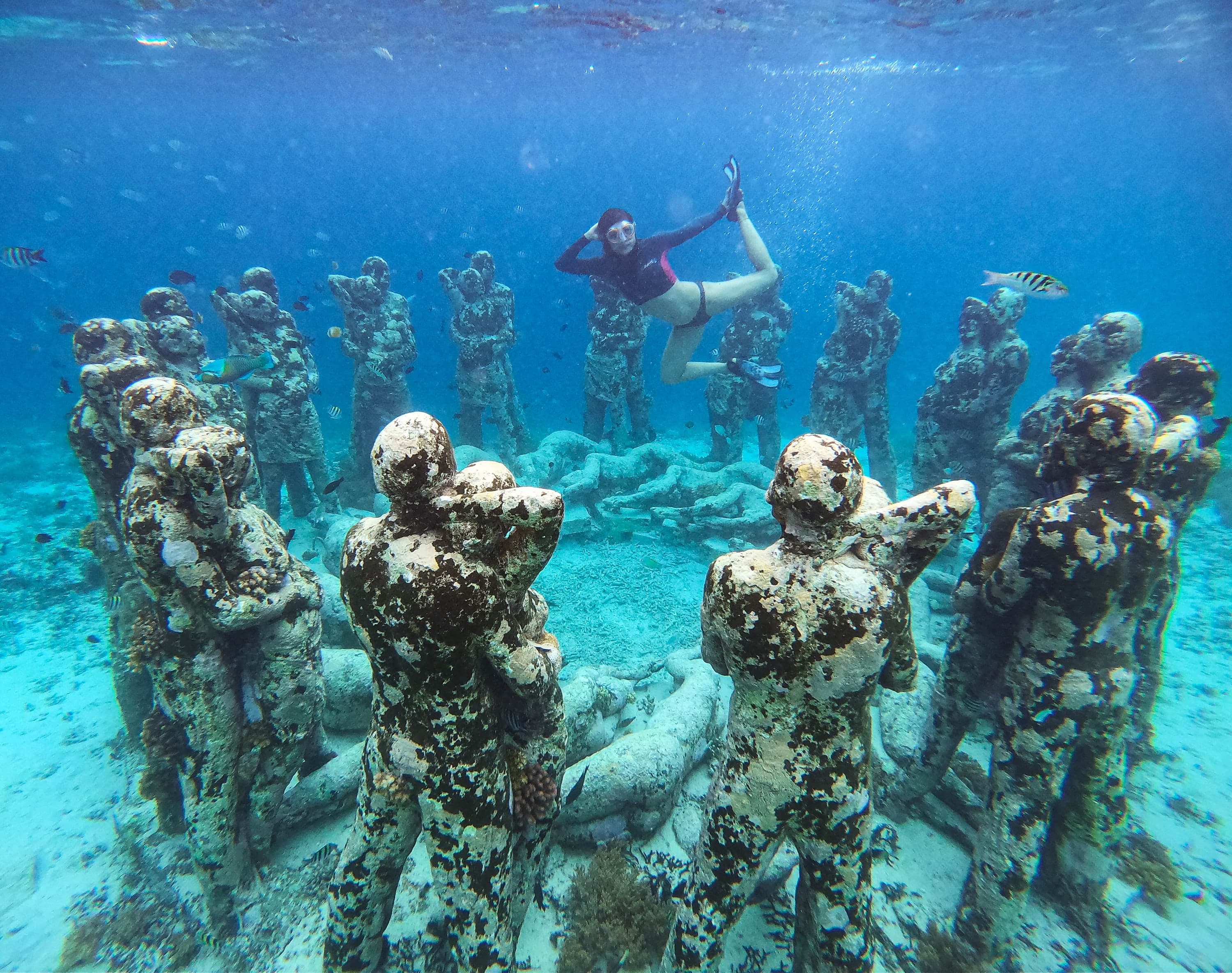
As so often, we explored the island during these 3 days mainly by swimming and snorkelling. We were only an hour's boat ride from Amed, yet underwater everything looked completely different. On Meno you snorkel over masses of soft corals, which were of course something completely new for us. Shades of brown in turtle-camouflage tones dominate. On the west side is the famous underwater statues photo spot. In the north you increasingly come across turtles grazing leisurely in the shallows – it's almost impossible to finish a snorkel without spotting several turtles. Our highlight: an emerald-green peacock mantis shrimp!
Also to be found underwater: anemones plus clownfish, lionfish, all kinds of small triggerfish species, titan triggerfish, various corals
Location: Gili Meno, west coast