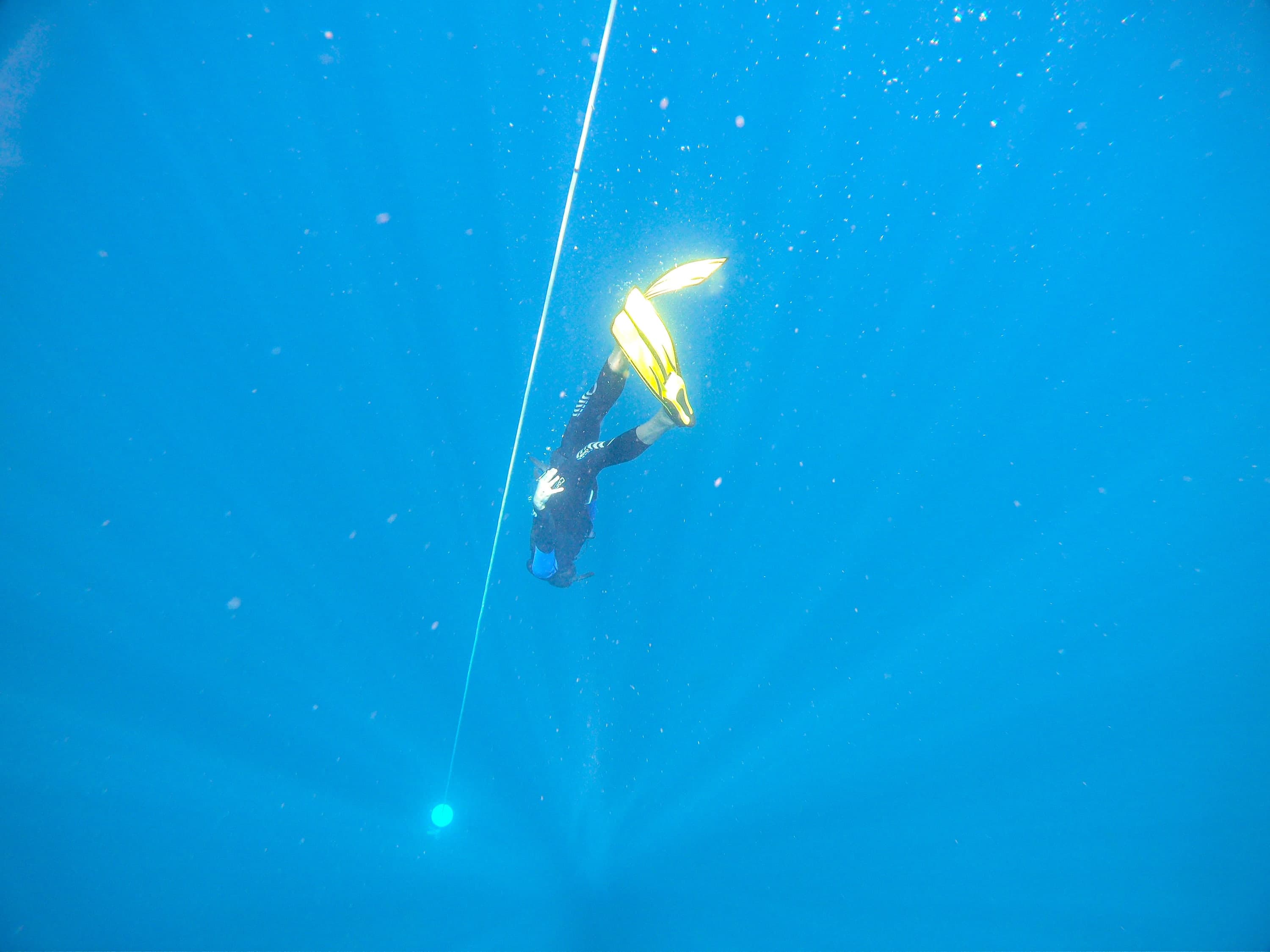
We dedicated our last 2 days to a freediving course in the centre of Amed. (Freediving means diving on a single breath – down and back up again with just one breath of air.)
When we first enquired, the high price of the course actually put us off. But after thinking carefully about the positive effect such a course could have for us – especially at the start of our globetrotting adventure, which is planned to be largely water-based – we simply turned a blind eye and took the chance to learn more about water and about ourselves from professionals. After all, we just happened to be in the one place that is considered a bit of a freediving mecca on Bali.
So we listened to the British freediving expert Anna and learned why it's fine to give in to the urge to breathe a little later, and how to follow a rope down into an ever darker blue calmly, with a positive attitude, a smile and a sense of anticipation.
My most important personal insight was that knowledge really is power. In this case, power over my fears and worries – and partly even power over my bodily functions.
Basically, we spent the last 2 days learning about the anatomy of all the organs and functions involved in breathing, right down to the smallest processes in our cells. We learned how to shift air around in different directions in the mouth and head, and how to gently teach our body that everything is still fine even when we're not getting any fresh air. We were shown and guided through new ways of equalising. That Chris can calmly hold his breath for 3 minutes in dry training was almost to be expected; I was quite happy with my 1.5 minutes on my first attempt, too. Something very educational and exciting for me personally was watching the oxygen saturation on an oximeter while holding your breath – and realising that no matter how badly you want to gasp for air, nothing dramatic is happening on the display yet, and it's all really in your head. Since Chris and I are probably rather relaxed people anyway, the dry and wet training wasn't particularly hard for us, as expected. That also showed in the 20 m training pool, where Chris swam 40 m and I swam 20 m underwater on a single breath without any problems – and with air to spare.
Feeling great, we went straight into the sea to the 10 m practice line – and, just like that, the problems and the big frustration arrived. Suddenly everything was in our heads again.
First we swam, very excited, 50 m out into the open blue to our practice buoy, with nothing beneath us but 40 m of blue depth – at least nothing we knew of – and thanks to the positive morning we didn't waste a single negative thought on potentially dangerous large sea creatures. The focus was entirely on the practice line and our dive instructor. Chris was the first to go down, reached the 10 m mark and we cheered. I failed at equalising after just 5 m – head first and by now in a somewhat less relaxed state, I just couldn't manage it. Since we had the luxury of our own instructor, Jan, just for the two of us, Chris and I could take turns trying again and again and were eagerly corrected by our coach. My equalising mark kept moving upwards, I got problems with my right ear, which frustrated me more and more until I really wasn't as happy as I had been in the morning.
Chris had pressure problems in his frontal sinus, and after he came up twice with a slightly bleeding nose, we decided to stop and had to kick our way back to shore against the current shortly before the other groups. On top of that we swam past a beautiful big jellyfish, but because of the training we didn't have a camera with us to capture it. Frustration at its peak.
After his "sinus squeeze", Chris decided not to continue the water part of the course so as not to risk chronic problems, and I was given equalising homework.
So there we sat, back at our accommodation, and neither of us dared to be the first to weigh the money we'd spent against what we'd experienced and say it out loud.
The next day started with yoga for freedivers, lung stretching and sharing our experiences. Pro Anna assured us that Chris's sinus squeeze was not a problem. I kept breathing eagerly in dry training and did my exercises.
She told us that our brain can only have either positive or negative thoughts at any one time, but never both at once. So the best trick is simply to fill your mind with positive things – and your head relaxes and there's no room left for worries.
With this attitude I went down 7 m on a single breath on my very first attempt without any problems, and I even had time to relax on the way up, admire the sunbeams in the wide blue and had no trouble equalising. In fact, I never felt the urge to gasp for air.
Now that Chris knew exactly which signals from his body to listen to, he dived down to 14 m without any problems – and then played rock-paper-scissors with Jan down there in the dark depths before heading back up on the same breath.
7 m remained my safe zone and personal best. Chris casually strolled down to 16.5 m and reached the reef below to watch fish with Jan.
It's quite a strange feeling to drift up top in the Indonesian sea, hanging on a buoy, and see nothing of your husband except a tiny yellow dot of his fin in the dark black below.
All in all, freediving was a super cool physical and spiritual experience. We're really happy we took this step on our journey.
Dive site: Jemeluk Bay, Amed, Bali
Freediving school: Apneista, Amed