As always when you approach something highly motivated, the beginning is packed with ideas and action, and only over time do you develop a certain calm and ease.
Since we were only at the beginning of our New Zealand exploration and didn't want to miss anything, the report you're reading now – about our first New Zealand experiences on the east coast of the South Island – is packed with lots of stops and new impressions.
Travelling in a camper van felt like a game in which you're thrilled about every additional checkpoint you reach. Photo proof is of course a must. It's definitely a great way to travel, and if you show great teamwork – as was the case with us, in my view – you fill your body and mind with quite a lot of feeling of freedom and positive energy.
And that despite currently using a home of no more than 5 m² for 2 people. Actually unimaginable, had anyone told us beforehand. You definitely learn how little you actually need to feel free and happy, and you become more creative in finding solutions for living in a small space. All the more you learn to appreciate the luxury we call our own every day in Austria.
Since we had quite a lot of respect for our first night in the car and weren't quite sure yet how Chris, at 1.90 m, would fit on the back-seat area of our Mazda Premacy converted into a bed, we treated ourselves to a rather pricey campsite at our very first overnight stop, in the small town of Timaru. That way a possibly uncomfortable night could at least be offset a little by nice communal facilities.
The campsite chain was called Top 10 and could be found well spread across the whole country. Depending on the location, you pay between €20 and €30 per night and vehicle for a pitch without power. In Timaru there was a well-equipped communal kitchen, shower cubicles with enough hot water and well-kept sanitary facilities.
And of course there was a bounce air bag you could use as a trampoline. Perhaps that also influenced us a little to spend the night right there 😉.
Close by was Caroline Bay, where we waited – unfortunately in vain – for our first encounter with the famous little blue penguins.
We were told they came ashore at dusk at the earliest, to nest and spend the night between the rocks separating the bay from the road.
As warm as the New Zealand sun had kept us during the day, it got all the chillier as soon as dusk set in and a little wind came up. We quickly realised that you have to get up early here to make the most of the dwindling hours of sunshine. So, like all the other tourists searching for penguins here, we waited dutifully and shivering behind our barrier. Volunteer wardens dedicated to protecting the penguins searched eagerly for us at the marked spots, to then lead the waiting people there. Just before we were about to give up, as the cold and darkness had won, a little penguin head was spotted between the rocks. Impossible for my eyes to make out in the darkness, and only vaguely noticeable for Chris, so we decided not to count it, and the penguin search definitely had to continue elsewhere.
At the next stop along our southern route, on the other hand, we got to spend a lot of time with animals. After a surprisingly comfortable first night in the camper van, we stopped at a wallaby farm and were allowed to feed the marsupials kept there. Actually, for us this is a very untypical way of watching animals, as we always strongly distance ourselves from keeping animals in enclosures. The real attraction here, however, was the extremely talkative New Zealand farm owner of a remarkably advanced age. She welcomed us, collected the farm visit fee and, without being asked, gave us important information for travelling around her home island. Among other things, always to have cash on you, i.e. to be prepared for a power blackout at any time, and to make sure the tank never drops below half full. We had already received the same and more tips from our last Airbnb host.
Wallabies are a genus of kangaroo that don't grow very big. Since we hadn't planned a longer stay in Australia but would have liked to see a kangaroo at least once in our lives, we took a quick look into the enclosures of this New Zealand marsupial farm. It was a bit like a counterpart to the Austrian deer parks, where you get animal food at the entrance to feed the animals through the fence. Here, however, you stood inside the enclosure and waited to see whether a wallaby would approach you.
We have somewhat mixed feelings about this stop, but still had quite a lot of fun feeding these, for us, extremely unusual animals and watching them hop around.
Just to make this perfectly clear: wallabies are not native to New Zealand. Nor are peacocks.
Here's a bit of information about the fauna of this breathtaking country. In the time after New Zealand split off from the supercontinent, a unique flora and fauna developed here.
The islands, with their large evergreen forests, provided the perfect basis for an incredible variety of endemic bird species.
There were no natural enemies on the two islands they had to seek shelter from or flee, so in the course of evolution some of the birds developed forelimbs unable to fly. The best known is probably the kiwi, which is now rare and which, unfortunately, we didn't see at all.
Unfortunately, many of these beauties are already extinct, even though they were native here not all that long ago – such as the moa, one of the largest flightless birds in the world. So you see, for big bird fans like us, New Zealand is the perfect holiday destination (if only it weren't so far away).
Our next stop with our mobile home was in Oamaru, right by the entrance to the visitor centre of the Blue Penguin Colony.
As you've learned by now, penguins usually only show themselves on land at dusk.
This place even offers seats on a grandstand and a VIP seating area, for a not inconsiderable price, to witness the arrival of the little swimmers in the evening, if you prefer that kind of animal watching. Since that's not really our thing, we strolled around the grounds (for free) and looked at the nesting boxes built for the penguins. In one of the little houses we could also hear a very young penguin chirping, eagerly awaiting the return of its parents in the hope of tasty food.
We didn't count that either as a reason to tick off "penguin watching" on our bucket list.
Where you find penguins, you usually find seals too – at least here on the South Island. So here we had a great opportunity for the first time to watch and photograph seals lazing in the sun up close.
A great stop, then, to stretch your legs and polish off the camper sandwich before moving on to find a spot for the night.
We found a sweet Kiwi campsite in Hampden, near the beach, trampoline included.
Kiwi campsites (in this country "Kiwi" is used as a synonym for anything New Zealand) are a little cheaper (8–30 NZ dollars). In return the facilities are often a bit dated and Wi-Fi isn't included for free. But who needs Wi-Fi when you have a place to sleep near a mystical coastal backdrop?
Barely checked in, Operation Penguin Sighting continued immediately.
A short drive away was Katiki Point Lighthouse, supposedly a top spot for watching penguins.
Just before closing time of the area, which is looked after by a Māori family, we hurried down the beautiful path to the end of the sheer cliff. From there you had a good overview of the cliff accesses where seabirds might come ashore.
We had about three quarters of an hour. There were no penguins, but this was probably one of the most glorious cliff backdrops I fondly remember. Definitely worth a visit! From high up we looked out over the rough New Zealand sea along the east coast. The wind blew hard and you pulled the strings of your hood tighter. The seagrass anchored in the water looked huge even from that height and cast a spell over you as it swayed back and forth with the waves.
Various groups of seals gathered on the rocks at the foot of the mountain. Large gull species unknown to us and the odd cormorant landed on the rocks here and there. Many a seal swam among the seagrass, probably to catch a fish.
Without a penguin photo but overjoyed, we headed back home to the campsite.
Before a well-deserved night's rest we went for a glorious long walk on the beach. Now we were confronted up close with the huge red-golden seaweed (kelp) lying around in the sand like enormous fringed leather rugs. The few people also strolling around were scattered across the sandy expanse, which is rather abnormally wide for Europeans. We even discovered specimens of a shark species unknown to us that had been washed up on the beach. Sadly, we suspect it was bycatch thrown away by fishermen – one of the reasons why we don't eat fish and don't support fishing.
The next day we set off again early in the morning to Katiki Point Lighthouse to enjoy the scenery without any time limit. This time some of the seals – which we now knew were New Zealand fur seals – were stretching out comfortably on the grass at the viewpoint in poses professional yoga teachers can only dream of.
Seen up close like that, the animals were pretty big and subtly commanded respect. We kept to the prescribed distance for dealing with wild animals as best we could, as noted again and again on signs. One seal bull lay so relaxed and camouflaged at the edge of the cliff that I completely overlooked it when I wanted to move up to Chris, who was standing with his back to me taking photos of the sea.
It reprimanded me with loud grunting and barking. Apparently I wasn't leaving its territory fast enough, although I had jumped aside in fright, so it decided to chase me off at a gallop and I had to run for it uphill.
If Chris knew what had just happened behind his back... That would have made a better video than the pan across the sea.
So much for there not being a single dangerous animal in New Zealand.
From then on I checked twice and three times whether a seal was sunbathing in my path.
It was time to move on. One last time I peered through a wooden fence separating us from a steep slope at one spot – and there it was. The long-awaited little blue penguin.
It was neither little – in fact rather very big and fat, lying flat on its belly on the rock – but it was clearly blue.
Mission successfully accomplished.
On we went to the Moeraki Boulders.
These are the mysterious stone spheres that have been exposed in slow motion over many millions of years from the clay wall lining this stretch of beach, and that slowly erode on the beach until they become part of the unique coastal scenery that magically attracts tourists.
These large boulders are best seen at low tide, and they probably make every geologist's heart beat faster. After all, they consist of exciting minerals, and some have cracked open from the inside, so you can see different colours.
With a few picnic stops, during which we got more and more familiar with our camping cookware and tried out a camping stove for the first time (yes, we're completely inexperienced when it comes to camping), we went in stages from one lookout point to the next.
We were able to watch the odd curious bird at our stops, as well as my new seal friends again and again, who sometimes stayed far from the water near the car.
We then found lots of bird species gathered together at the Hawksbury Lagoon Walkway, already further south. This was a lake area where, besides my first New Zealand sunburn, we got to see many different kinds of ducks and the famous black swans.
We also found royal spoonbills here – whose pink relatives we had only ever encountered in Costa Rica – as well as cormorants and herons.
Birdwatching was also on the plan for the next stop. Before that, however, it was time to visit a freedom camping site for the very first time, in Dunedin. These are free pitches provided by the city that may only be used by self-contained vehicles. In return there are no other facilities, reception or any other luxury. It's simply a car park. But usually a portable toilet is provided. The "first come, first served" principle applies.
We found the location in Dunedin perfect. I used the sanitary facilities of the neighbouring sports ground to avoid the portable toilets, and with 2 night-time trips to the loo I also reached my step goals.
We got dinner and Wi-Fi from the nearby Pizza Hut and then holed up cosily in our vehicle for a movie night.
If you want to experience birds up close, we can warmly recommend the Orokonui Ecosanctuary. It consists of an area kept 100 per cent predator-free by a modern protective fence system. So not even the smallest rodents (all of which, as we now know, were only brought here by Europeans) can get into the area and threaten the cute birds.
You can really notice this in the behaviour of the birds in this unique forest area, which is crisscrossed by nature trails.
We had super sweet, trusting and curious companions here, who behaved as if we were the ones to be observed.
We also came across the rare South Island takahē drinking water.
The somewhat shyer larger bird species such as the kākā (a parrot) and the tūī can be encountered at certain feeding stations and watched from platforms at a distance, if you don't meet them on your forest walk anyway.
Since we still hadn't had enough of bird species, an albatross-watching tour by boat was also on the programme – to the only colony that can be found on the mainland.
We passed the time until the tour started with another walk on a nearby beach, during which a seal came crashing out of the man-high reeds on the land side and grunted at me as I happened to walk past. The seals apparently had no problem with Chris, although he took photos of them quite unabashedly. My small stature, however, seemed to give the males motivation to show off.
On the other hand, I discovered one of my new favourite birds on that walk.
The South Island oystercatcher:
At the jetty from which our boat departed, we even spotted a penguin in the water.
The albatross tour was interesting, and we found the captain's announcements in New Zealand English, unfamiliar to us, extremely entertaining. Since it was a very windless day, the albatrosses struggled with landing and taking off. So we saw them gliding in the air more. They are of course really impressive birds with an impressive wingspan of 3 metres (!). Still, we also found that from a distance they just look like big seagulls.
By now we had settled well into camper-van life and had covered almost the entire east coast.
We were already more or less at the curve of the coast that marks the beginning of the southern part of the island. The landscape began to change, and our routes slowly led us inland, where we explored New Zealand's evergreen forests for the first time.
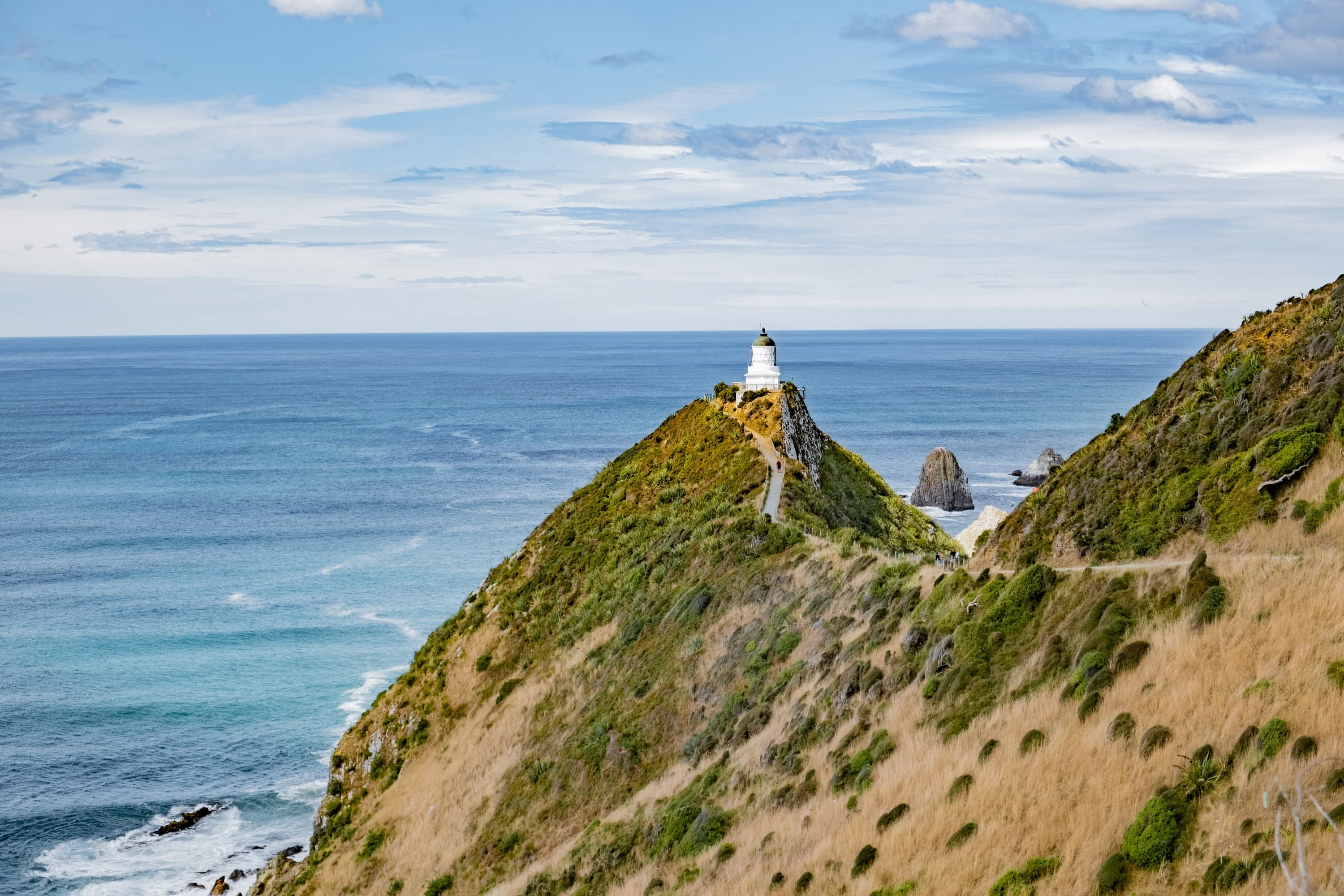
The last coastal stop was Nugget Point Lighthouse, whose view you simply have to have seen.
The lighthouses here stand at the most indescribable natural sites. There's a short walking track up to the lighthouse and the viewing platform.
The path itself is already a postcard motif.
But what then appears behind it is another reminder of the beauty nature displays – managing, through the placement of rocks, seaweed and sea foam, to make us perceive a rugged, inhospitable backdrop as romantic and calming.
And as the icing on the cake, a seal performs its pirouettes in the water and dives playfully through the seagrass while we breathe in this picture.
At this point we began hiking to waterfalls, starting with the McLean Falls, hidden at the end of a short forest walk.
As a traveller from Europe, the first thing you probably notice is the light green moss growing on all sides of the trees – which certainly can't help you tell north from south.
Enchanted forest would be the right term here.
When we arrived at the falls, it was clear that this was a perfect acro yoga photo backdrop.
Here the route along the east coast really did come to an end – as does this first long part of the report on our New Zealand adventure.
In the evening sun we drove up gravel roads into the interior (the only car around), past a dense wall of forest that reminded us of Fangorn, the legendary forest from The Lord of the Rings.
Researching afterwards, we found out that some scenes of the "Lord of the Rings" films were actually shot right here, so our comparison was spot on.
Enjoy our video compilation and the pictures – choosing them is getting harder and harder for us. In New Zealand almost every photo shot from the hip looks like a postcard. We hope this lets us share a little of our impressions with you.