So we were now in the Southland District on New Zealand's South Island. Our base was the small town of Te Anau, where, with the coming rainy days in mind, we treated ourselves to one of the premium Top 10 campsites.
Since many more of those days would come – it was slowly but steadily getting wintry and cold – we decided to take out a membership. We want to mention this here because it's a great tip for anyone else embarking on the "New Zealand road trip" adventure. You get the price of the membership back through the discount you get when booking the ferry to the North Island with the partner company, and every Top 10 also has little goodies ready for members. So we often used a free jacuzzi/hot tub and were given T-shirts on the jet-boat ride in Queenstown (which is pretty handy on a world trip with few clothes).
Southland is known for its fiords and hiking areas. Since it's a region that's hard to settle, it's still very natural. (The population density here is roughly 1 inhabitant per km².)
Here in the west of the district were, so to speak, the New Zealand Alps as well as Fiordland National Park (another UNESCO World Heritage Site), which of course we wanted to explore at least a little. That's why we had chosen Te Anau as a stop, with its strategic proximity to the fiords.
Since my hip impingement wasn't behaving at its best after the many hours in the car, Chris got me a hiking pole, after fierce resistance on my part. At least I managed to make sure it was only one and not two. But I couldn't and didn't want to get used to the idea of always taking a pole on longer walks from now on, especially here in the mountains, constantly reminding me that I'm no longer 15.
A new travel friend from the USA had said a few months earlier that you could always recognise Austrians by their Patagonia outfits and a hiking pole. Now I probably met both criteria.
At one of the town's tourist and visitor centres we booked 2 of the possible tours. This is the only time on this flexible and very spontaneous trip that we booked an activity in advance. In New Zealand you can generally be very spontaneous. The only and most important exception is the car ferry between the North and South Islands! You may even have to book it a month in advance, ideally with a flexi ticket.
Planning ahead made the decision for us as to which of the famous fiords we wanted to explore by boat, since we simply looked for the next available activity – always taking the weather into account. So we booked a boat tour on Milford Sound (which is a fiord) for the day after next, and a tour of the nearby glowworm cave on the other side of Lake Te Anau for 2 days after that.
So we had a whole day to drive along and explore the Milford Road, probably one of the most famous driving routes in New Zealand.
In short: you drive a breathtaking picture-book route from Te Anau to the harbour where the Milford Sound boat tours depart. In theory you could do it in about 2 hours, but the idea is to experience all the wonderful highlights along the way – waterfalls, hiking trails and lakes – at leisure. So you should allow at least 2 days for the route. But you could certainly also spend a week or more doing the multi-day hikes such as the famous Gertrude Saddle.
We stopped for a very short walk along Mirror Lake.
You can probably easily see from the photo why it's called that.
Can you tell at first glance which way is up and which is down?
You had to remind yourself to let your gaze wander so as not to look at just one spot of the lake the whole time – when everything was simply beautiful wherever you looked.
In the water we even spotted one of the endemic eels.
Next we visited the equally picturesque Lake Gunn. To see it from a small reedy bay, though, you first hiked through a real, rustic enchanted forest. In our previous report we had already described how much moss you find in the forests here. Now we knew that everything before hadn't been even remotely the full extent. Here it seemed as if time had stood still. What would be cleared and replanted back home simply stayed lying here, so moss and other growth could peacefully cover and recycle the old wood. Looking closely, you could even see miniature forests of various tiny plants on the trunks of the huge old trees. We had never seen such a beautiful forest before.
If you could ever describe a forest with the adjectives "soft" or "cuddly", this was the case.
Next we headed to the Christie Falls. These mighty waterfalls and the rapids that follow are conveniently located right on the Milford Road. A great spot to stretch your legs for a moment and be impressed by the loud roar of the water.
It's simply relaxing to watch water flow. The clarity and purity of the water here was also remarkable. Just a typical, healthy mountain stream.
All the other tourists who also stopped here went on their way after looking at the water.
We, however, had found another marker on Google Maps for a waterfall at this spot that could supposedly be reached via a hiking path.
Right next to the start of a short bridge we found the typical green D.O.C. (Department of Conservation) sign that marks attractions and tracks all over New Zealand and tells you how long they take. But since there was no clearly recognisable path – you simply stood in front of a steep, green, overgrown wall, and only after looking for a while could we make out a kind of track in the bushes – it was now clear to us why nobody else had bothered with this second waterfall.
For us, of course, this was a clear invitation to clamber around in the forest. So we happily set about following the non-existent path. Since we knew where the water of the lower waterfall had to come from, the direction was clear: up. In addition, a discreet little orange triangle on some trees marked the way.
Our way led over rocks and steep undergrowth, and at one point we even had to scramble up along the huge roots of a tree.
We realised that scrambling here was so much more relaxed than on our climbing trips in the Philippines or Indonesia. After all, there isn't a single dangerous or venomous insect, no snake – in fact there aren't even supposed to be any mammals – so you can safely cling to any rock, branch or piece of ground. Maybe you still remember the report from Sumba (Indonesia), where I stumbled around the jungle extremely clumsily because I wasn't willing to hold on to trees or rocks, and in the end swam back down the jungle river instead. Those were quite different thoughts and feelings.
(Photo from the Sumba report)
Here, then, you could safely touch everything, and the soft moss was even pleasant.
In any case, we were super happy when we reached the upper waterfall, called Falls Creek Fall, and couldn't believe our eyes.
I declared this waterfall the most beautiful of the whole world trip so far. But also because, exactly when we reached it, the sun was positioned so perfectly that the high humidity created two perfect rainbows. And that right in the middle of moss-covered rocks, here all alone, just for us and the hidden waterfall. What a moment.
The roar of the masses of water crashing into the pool below was so loud that we could only communicate by shouting.
So we were richly rewarded for the steep climb and then set off on the exciting and somewhat slippery descent.
The last possible campsite (this time a D.O.C. one) was a little way back at Lake Gunn. D.O.C. sites were a bit more expensive and usually had no other facilities apart from a public long-drop toilet. In return, they were located in the most beautiful spots in New Zealand, always close to the entrance of a national park.
So here, as always, we spent the night in the car, with a view of the New Zealand Alps and, in front of them, a field of lupins that had unfortunately already finished flowering. At night we were treated to a dreamlike starry sky in the middle of nowhere, without any light pollution far and wide.
Since we had liked the nearby "Lake Gunn Nature Walk" so much during the day, we decided to go on a night walk here on our own. So we put on our few long clothes in layers (it was really cold here at night), packed the torches and set off for the enchanted forest. A very relaxed undertaking, since we knew there were no dangerous animals here.
In almost every country of our long trip we had always done a night tour on land or in the water. By comparison, this was one of the strangest experiences so far.
There were practically no night-time sounds. Not even a chirp, and no rustling in the bushes either. In the torchlight the moss-covered stumps looked like little gnomes. Quite unusual after the many jungle tours in Southeast Asia, where we had already come across small wild cats and tarantulas. At least an easy night-time activity to get a few more steps in. An extremely unusual country, this New Zealand.
The next day, after an hour's drive, our Milford Sound cruise tour began. We almost missed the ship, as we had somewhat underestimated the delays caused by roadworks along the route.
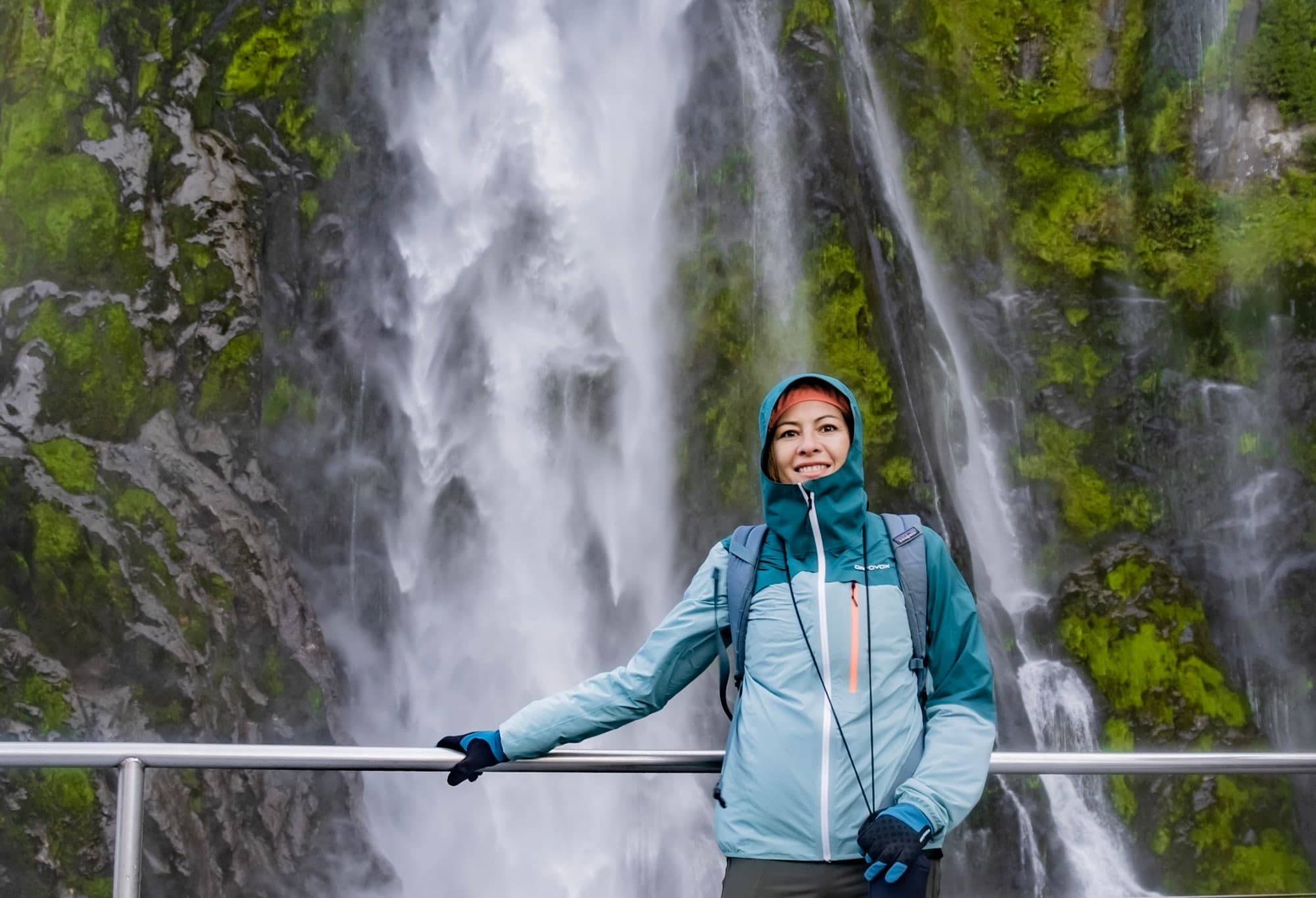
Over his microphone, the captain shared all kinds of interesting facts about the fiord, the area and the waterfalls. Soon we had to pull up our hats and hoods, and here too the second layer of long trousers worked well against the cold.
So we sailed at a brisk pace along the waters of Milford Sound towards the Tasman Sea.
Milford Sound was a big, wide fiord – but according to the captain, by far not the widest in Fiordland National Park. In any case, impressive mountain landscapes rose up to our left and right.
Milford Sound is known, among other things, for its numerous waterfalls, which fill up even more on rainy days and carry huge masses of water into the sea. We, however, were glad to have caught a mild, sunny day. Now and then we even went into the sheltered indoor areas to warm up a little.
We deliberately sailed very slowly past a twin waterfall where beautiful short rainbows formed. So everyone had enough time to take photos, if their cameras could withstand the humidity or were protected.
For a short stop we went very close to one of the best-known waterfalls: the Stirling Falls, which are 151 m high.
A hugely impressive experience to see all this water crashing into the sea from that height and how it affects the surface of the water. (Our short video is worth a look for this too.)
Towards the end, just as we had positioned ourselves on the lower deck at the bow, dolphins accompanied us for quite a while. We could experience one very close up as it swam playfully in the bow wave just below us.
Back on land we headed back to our faithful vehicle – only to find that one of the sliding doors hadn't been closed properly, and in our hurry and fear of missing the ship we hadn't noticed. So the car hadn't been locked at all. What a shock! My first thought was that with this way of travelling, really EVERYTHING always stayed in the car, except for the little you had with you in your daypack – which you didn't want to pack too full for the long hikes either.
It was also the first car park where a lot of people were around, since Milford Sound is a big tourist attraction.
But everything was fine. Nothing was missing. Nobody had cleared out our car – nor, unfortunately, tidied it up. Everything was in its usual chaos. After all, we were in a country where many residents don't even lock their houses and vehicles, and Airbnb owners leave the key under the doormat. And since there were more sheep and tourists than inhabitants, especially here in Southland far from any big city, the crime rate probably wasn't very high.
Besides, over the years we had learned our lesson and invested in a travel safe. Of course we use it dutifully, especially here in the car. We can also recommend this to all travellers. That way the most important items such as passports, cards and cash are safely stowed in any case, and you feel better on the road – even if you've forgotten to lock the car.
Since we had covered quite a long distance by boat and car, but none of it could be called sporty, we decided to do one of the possible hikes on the way back to Te Anau that day.
According to information signs, people who weren't completely fit – like me with my hip – and those without the right mountain equipment were advised against the famous Gertrude Saddle, a pass crossing. So far all the hiking trails had actually been quite easy and, if anything, too well prepared. Nothing compared to the "easy" walks on Nusa Penida, Indonesia, where you suddenly found yourself in the middle of a via ferrata without any belay. Still, we decided to simply let Gertrude be Gertrude and not to risk anything.
Thanks to this decision, we got to enjoy another really great, exciting long hike with a rewarding mountain lake at the end:
The Lake Marian Track.
The start was via a suspension bridge just behind the car park. Then you walked a stretch along a handsome river before the path led into an interesting section of forest. Here it wound through the forest over sticks, roots and rocks, uphill most of the time.
Again and again we met nice fellow hikers who told us how far it still was, or how close the goal already was. We hiked a whole 2 hours until we reached our goal, the mountain lake Lake Marian. It was a dreamlike sight. Crystal-clear water, surrounded by beautiful high mountains.
We walked a little further along the rocks of the lake, where we could clearly feel the power of the New Zealand mountain sun. Finally we found a suitable spot for our well-deserved sandwich.
It didn't take long before we were sitting in our underwear on the big boulders, dipping our feet into the ultra-cold water and eating our well-earned snack.
Although Chris is normally the one who avoids cold water, this time he was braver than me and dived headfirst into the mountain lake without thinking twice. I could only bring myself to dip in up to my thighs. Afterwards I was pretty jealous that I hadn't gone through with this refreshing experience too – especially with the coming descent in mind.
We rested enough, took a few more photos of this dream backdrop and then soon started the long descent, to round off the evening after 4 sporty but happy hours.
Of course we also managed a few lookout points along the way.
Back in Te Anau, the Kepler Track was still waiting for us, part of which winds around Lake Te Anau.
But since we could still feel the previous day in our legs, and the forest in the first section of this hike, while beautifully green, wasn't quite as captivating as the forests along the Milford Road, we turned back after a leisurely 2 hours. The Kepler Track is also a multi-day hike, and the highlights of the route are probably only found on the later, higher sections.
Soon we would move on to the next region of the South Island. But before that, the next adventure was waiting for us. We still had our ticket for the boat trip through the Te Anau Glowworm Caves on the other shore of the lake.
So we imagined a cave buzzing with glowworms.
It wasn't like that.
We can now clear up a big misunderstanding of the German language:
At least the following was new to us.
In German we use one word for two different kinds of animal. One are fireflies (beetles) and the other glowworms (larvae). But we translate both as "Glühwürmchen", even though one kind flies around and the other hangs or crawls.
New Zealand has several well-known areas with a high number of glowworms.
The Te Anau Glowworm Caves we got to visit are one of them.
First we crossed the lake on a fun boat ride.
After a short walk into the cave, we were seated in small boats to be manoeuvred through the cave in absolute darkness by a trained guide. The whole thing worked with a system of taut ropes that the boatmen used for orientation and to pull themselves along. So you glided through a mystical dark cave, which in certain places was covered by a surprising number of neon-green glowing dots that looked like a starry night sky.
The worms and their glow vary depending on their age. They form strings of beads made of the finest slime that hang down from the ceiling. With the help of these threads they can catch prey – such as smaller flying insects that have strayed into the cave, hatched here or been washed in, and now try to escape upwards towards the starry sky.
This is a truly fascinating way to experience these little animals up close. Although, after our cave guide's helpful advice to keep our mouths firmly shut when looking up, we were glad not to have experienced them too closely. The worms drop the shells of the insects they've eaten, and the strings of beads are, as mentioned, slimy.
We really enjoyed this trip, and it was very educational to learn all sorts of things about these interesting little worms.
Since all this happens in absolute darkness, we can't post a photo of it. But let your imagination run free and picture a damp cave whose walls sparkle in neon yellow and green. It's a bit reminiscent of an artificial starry grotto in an Austrian thermal spa.
A beautiful finale, then, to leave Southland behind us and open a new region in the New Zealand road trip chapter.
As always, enjoy our compilation of moving pictures and the photo gallery. We'd be happy if you left us a comment.