West Sumba
I could tell you more about my impressions of Sumba than about everything we've experienced on Bali so far. Sumba is actually part of the breathtaking island nation of Indonesia, but it feels as if you've arrived in a completely different country again.
Sumba is one of the southernmost Indonesian islands and is rarely visited by European tourists. That's probably partly because it isn't easy to travel around there, and partly because it's classified as a high-risk malaria area and there is no good medical care. Head lice are still a widespread problem here, and you're advised against driving yourself. So for some a rather off-putting destination – but it's exactly this kind of material that the best adventures are made of, the ones you'll remember for a long time. Perfect for us, then. Sumba is often described as an island where time has stood still. Ritual animal sacrifices are still common here; the human sacrifices (slave sacrifices) we were told about were abolished long ago. The faith of the Marapu people, widespread here, is animist, and people believe that objects as well as sacrificed people and animals will continue to accompany the deceased into the afterlife.
This island had so much information, so many impressions and so much culture that was foreign to us. We were hugely excited to be an observing part of it for at least 9 days and to learn new things.
We landed safely at Tambolaka airport in a small aircraft, the only plane on a micro airstrip, and had already mentally prepared ourselves for things to work differently here than on tourist-packed Bali. The island welcomed us with dry heat. We had booked one of the island's rare tourist accommodations in advance. A driver was waiting for us at the airport who didn't speak a word of English, but brought us safely to our lodgings in his older, non-air-conditioned vehicle. It was actually only a short distance, but the last third led at what felt like 3 km/h over rough terrain along a dusty steppe "road", past dry bushes and cashew trees. The desert-like landscape strongly reminded me of our earlier stay in Madagascar.
When we arrived, it surprisingly turned out that the lady of the house, Ibu Sisca, spoke good German as well as English, as her late husband had been German. Her nephew Mario, who works there, also spoke very good English, and we felt well looked after.
Soon we were given our hut and could move into our home for the next two nights.
We had a spacious hut with an almost intact mosquito net over the bed and a fan that was supposed to cool us down a little. Electricity came from a solar system that had seen better days and only occasionally felt like doing its job. Our open-air bathroom with a rice-straw roof, built onto the hut, consisted of a washbasin (including a scorpion as a welcome), a toilet, a shower corner and 2 large water containers with ladles. We soon realised that the containers and ladles were our hands-on toilet flush as well as our shower and washing facilities. After Chris had lovingly relocated the scorpion back into nature, as far as we knew we only shared the hut with an ant colony and a large one-eyed gecko, whom we tasked with dutifully eating all the mosquitoes.
We explored the stretch of beach right in front of our accommodation. You climbed down a little path and found yourself on a picture-book beach that was almost deserted. The volcanic rock wall lining the beach was sharp-edged, dark and porous and formed beautiful man-sized hollows that the sea had washed into it.
At a height of 2 metres we even discovered large fossilised nautiluses, which let you feel the age of the island and how long ago this rock must have been pushed up. I found it even more amazing that this stretch of beach was so untouched that the fossils hadn't been removed and put in a museum yet. In any case, I found the discovery extremely exciting and felt like the cartoon character "Dora the Explorer" in search of new discoveries.
Various whale bones and buffalo skulls were also lying around the accommodation as decoration waiting to be discovered, because some time ago a dead whale had washed up on exactly this stretch of beach. Mario explained that traditional whaling is practised on the nearby island of Flores, and this whale had probably survived it and made it over here before it died.
The cook there made us what was probably the best fried brown rice of our whole Indonesia trip, and we went to bed early to be rested for the upcoming day tour in the west.
Since I couldn't quite get the head lice and malaria mosquitoes out of my head, I slept cosily in my cotton travel sleeping bag with Insect Shield technology despite the extreme heat. All the more refreshing, then, was the morning's unheated splash of water from our ladle-and-bucket combination.
For the day tour we waited for Dany, the betel-nut-chewing driver who had picked us up from the airport. (Betel nuts keep you awake longer, similar to coffee, but they're highly addictive and stain your teeth and gums red.)
Ibu Sisca packed the delicious fried rice into a lunch box for us. Mario helpfully joined us as our interpreter. We were super glad, because without him we would hardly have managed to communicate with Dany or have had much of the culture explained to us.
We visited a traditional Sumbanese village and learned a lot about how the bamboo huts on stilts with their high pointed roofs are built.
A hut is a shared home for the whole family; everyone has their own allocated living corner. There are no bathrooms. The dead are buried in an extremely elaborate funeral in a stone tomb in the form of megaliths in front of the huts or in a village cemetery. Until the family can afford this event, the dead lie embalmed in decorated wooden boxes wrapped in expensive textiles (ikats), also inside the huts. This can take several years or even decades.
The families own water buffalo, which are sacrificed and given as gifts by friends on such occasions. Their skulls and horns are considered status symbols of wealth and prestige, but also serve as a reminder and as a reason for telling stories about who brought or bequeathed which skull or buffalo to whom, and when. The skulls are mounted and collected on the front of the huts. For us European adventure travellers these are, of course, exciting photo motifs and stories.
After the village visit we drove to a viewpoint on a cliff (Pantai Mandorak). There we found indescribably beautiful cliffs with a view over the cobalt-blue sea. A little further down, in a bay, you could take great photos on the white sandy beach.
The stretches of coast we visited weren't suitable for swimming, as there were too many currents. There are also no speedboats or jet skis here that could bring you back in if you got pulled out. That's why our snorkelling trip at the accommodation on the first day had been a little shorter than usual – we were the only ones in the water far and wide, didn't really know the area yet, and visibility wasn't good either.
So on Sumba we mostly skipped swimming in the sea. Which doesn't mean I didn't go swimming, or that we didn't get wet every day – but more on that later.
Along our route we also visited a fishing village (Pero Beach) that specialised in catching and drying squid.
For lunch we stopped at a stunningly beautiful huge lagoon, Waikuri Lagoon, with turquoise-blue water. There was even a jumping platform for Chris.
There were very few visitors and you had the whole lagoon to yourself. The food we'd brought tasted excellent. Sisca had also packed bananas for us, and we treated ourselves to a young coconut on the spot.
After this great finale, our group of four set off on the somewhat longer drive home, as the days end early here. You then fall into bed exhausted and pack everything for the next day, ready for more adventures.
On the drive home we passed burial monoliths every few metres and realised that these didn't just belong to the traditional villages – simply everyone on Sumba, Christians included, buried their dead in the front garden. Later in East Sumba, for example, we saw Marapu-style monoliths with a cross on the front. The tombs are part of the typical Sumba landscape and unique in Indonesia.
Dany agreed to drive us to accommodation in the south the next day for a good price. It was a longer route, and as a stopover Chris had once again planned, among other things, a great waterfall for us. This time, though, without Mario, our interpreter. What would we do without mobile phones? I felt pretty cool being able to chat with our driver by typing my questions into the online translator whenever there was mobile signal, then reading the text out to him while gesturing wildly and trying to make the right face to go with it. Our driver Dany, who kept chewing on his betel-nut paste, spoke almost no English. When he laughed, it sounded like one of Bud Spencer's hearty laughs from the old films. Sometimes a laugh like that was also the answer to my question, which he probably hadn't understood.
In total, Chris had picked out 3 more sights we could tick off on the way to our accommodation. Chris knows how much I love waterfalls and had put together a Sumba route with as many great waterfalls as possible. So our first destination early in the morning was a waterfall (Air Terjun Tokomboro) far from the main roads, so that even our usually knowledgeable driver often had to ask for directions. Here too we were able to help with Google Maps. When we arrived at the car park, Harry, a local guide who was to lead us to the waterfall, was already waiting. So we happily trudged off with our camera bag and our most important belongings in the backpack. Right behind a house we headed cross-country into the jungle along paths that weren't recognisable as such. I tried hard not to lose sight of our guide and to watch where he stepped. Since our previous adventures had given us great respect for Indonesia's high density of snakes, the hike already felt very adventurous – especially as we were only wearing shorts, since the previous waterfalls had been reachable on easy hiking trails. The path got more and more slippery, so that you were supposed to hold on to plants and rocks with your hands – which I avoided at all costs, because I didn't want to grab a snake or spider anywhere. As a result I developed a very clumsy way of walking and stumbled through the jungle more badly than well.
I had to laugh so hard inside when I pictured myself trying to keep up with Harry while staggering around like a stumbling alpaca. Chris probably didn't notice any of it because he had to concentrate on the path himself. Things got really chaotic when we had to cross the river for the first time. With hand signals, our guide told us to balance across the slippery stones to the other side, and we tried to ask him with hand signals whether our luggage wouldn't get wet. Harry didn't speak a word of English either. As a result, he went ahead, Chris threw the luggage across to him, and then the whole group (our driver had joined us on the adventure) tried to climb or even jump from one slippery rock to the next. With my 1.6 metres that soon stopped working, so early in the morning I had to swim from rock to rock fully clothed, only to keep stumbling through the equally damp jungle – now as a soaking-wet alpaca. I'd never experienced anything like it. Chris and I once again had a huge amount of fun, and I couldn't stop laughing. When we finally reached the waterfall, an extremely rewarding sight awaited us.
Because the rainy season had just started at that time, the fall was fed with a lot of water. Holding our hands, Harry led us right up close to the water and offered to let us swim in the "natural pool" – we didn't have to think about it for long, as I in particular was completely soaked anyway. Once again it was very important to our two Indonesian companions that we really took lots of photos. They photographed us with their own phones too and also wanted to take pictures together with us. When the photo session was over, we started the descent, which turned out to be an even bigger slip-and-slide. At the key spots it had become impossible for me to climb, as I was only sliding around anyway, drenched as I was. Rather than scraping my legs, I decided to gather all my courage and, instead of climbing back along the river, to swim back to the start. I tried to keep my thoughts away from possible water snakes or other creatures in the brown water, while the boys dutifully climbed back with our luggage. No matter what came next, the day was already a great adventure success. Back in the car and on our way, we stopped after only a short while to film the swarm of locusts that was raging over exactly the area we were driving through. We'd never experienced anything like that either. Biblical conditions.
(if you zoom into the forest, you can roughly see the size of the swarm)
So on our second day Sumba was already showing us its full range of natural spectacles, and the day was already unforgettable. However, I decided to mention to Chris that it might not always be necessary to visit every single impressive waterfall deep in the jungle that he finds on Google Maps in order to make me happy.
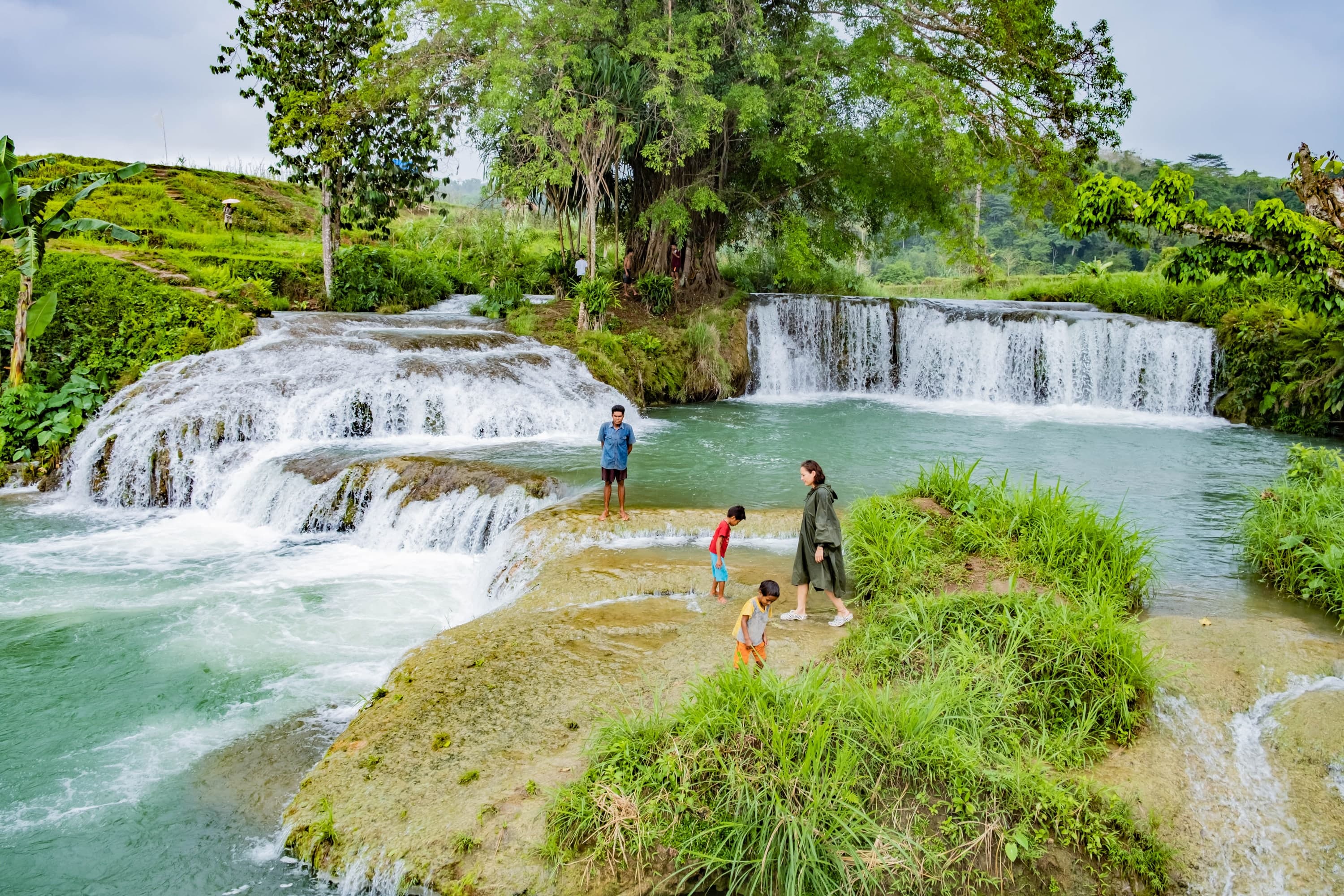
The next stop, then, was a waterfall (Bendungan Weikelo Sawah / Wee Kacura) in the middle of a rice field complex. (I love this man.)
It started to rain, but that didn't matter to us, as we had our ponchos with us and were still a little wet anyway. In the rain we hiked with a rice farmer and his children through what was probably the most glorious rice field landscape imaginable. He led us right through the fields, sometimes even straight across them. We can now claim to have seen rice fields up close. It was still so slippery that the farmer often held our hands to support us, as otherwise we would probably have ended up on our bottoms. One of Chris's flip-flops said goodbye and tore when he slipped at a tricky spot. He got to walk back through the rest of the rice fields barefoot. A highlight was the beautiful wide waterfall in the middle of the fields, over whose step a field worker led us with a firm grip, an umbrella and a machete to get to the other side.
When we got back to the car, a total downpour broke out of the clouds, making the onward drive as wet as it was exciting.
When the rain eased off briefly, we visited another traditional village on the way, Prai Ijing Village.
Right afterwards the rain broke through again. So we decided not to make any more stops and drove straight on to our accommodation, where a spectacular beach thunderstorm lasted all night.
Dany must have had quite a lot of fun with us. After all, he offered to be our driver for the following days too, to accompany us to the other side of the island in the east and then take us to the airport.
As always, here are our video summary and pictures.